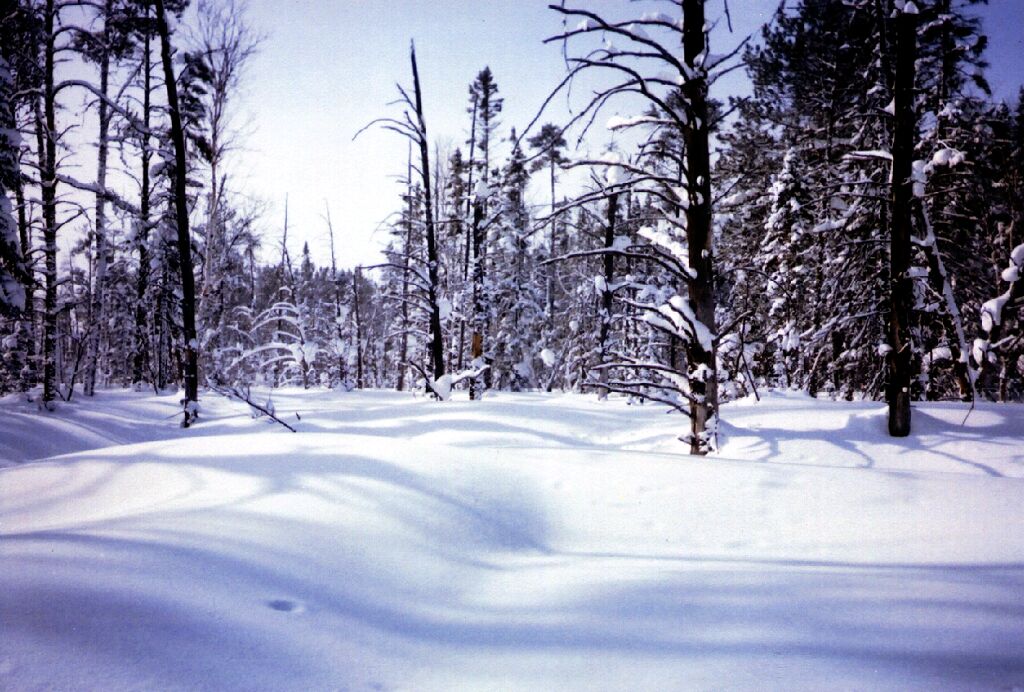
The trees have a tough go of it in the bog here, and grow sparsely, and while they may live long in years, they grow slowly, stuntedly, and usually die before reaching much size. Because peat bogs are naturally somewhat antibiotic or preservative, the roots will not rot away, as they would on a dead tree in a normal forest. Because of this, the dead trees stand for many decades after they die, most often slowly disintegrating from the top down. First the small branches go, then the bigger ones, somewhere along the way most of the bark, then then the largest branches, then perhaps bits of the standing trunk in sections and slivers here and there. .....Until only the stump remains at the ground, with the roots still mostly undecayed. Interestingly, even this process is slow. The standing trunks seem to be more 'dry rotted' than anything. They stand in water and saturated ground, but above the waterline, the sun bakes hot in the summer, there not being enough trees to make for significant shade or keep the wind from circulating freely. Things dry quickly between rains. Snow offers little moisture, since it is usually dry, and then falls or blows off mostly before it can ever melt in to the wood.
Black spruce does better than the jack pines in these areas, but still there are effects. Here you can see how black spruce grow absurdly tall, with only a couple feet of thick greenery near the far top above thin branchless trunks. The trees with the arched limbs along the trunk are--or were, as the case may be--jack pines. Red and white pine are not directly visible, but are mixed into the areas where the trees are seen to be thicker to the right and distance, where it is just barely a bit drier.
NEXT